
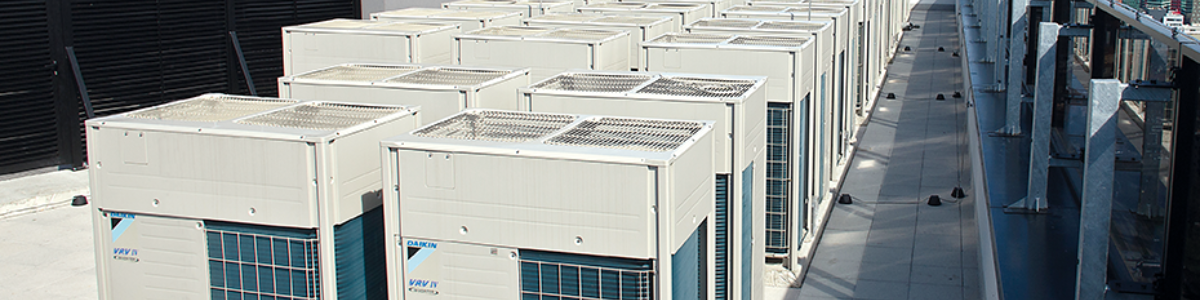
Do you need a new air conditioning system for your New York City office this year? Here’s an option you should consider: a VRV or VRF system (which stands for variable refrigerant volume or flow) has many advantages for commercial spaces.
Benefits of a VRV or VRF system
The benefits of this technology include improved comfort, saving energy, and customizable operation. In a nutshell, these are the advantages of a VRF system or VRV system:
- Consistent comfort
- Quiet operation
- Energy efficiency
- Installation flexibility, great for tight spaces
- Heat & cool simultaneously
- Zoned heating & cooling
- State-of-the-art controls
- Fewer breakdowns/less downtime
- Remote monitoring capability
So, what exactly is a VRV or VRF system? To understand the benefits, we’ll start by explaining a little bit about how it works and how it’s different than a split system or a rooftop unit. Then we’ll explore each of the benefits listed above.
VRV/VRF systems: maybe it’s time to jump on the bandwagon
Though most of us are familiar with the traditional HVAC system that consists of a large central unit pumping out air to our entire space, VRV/VRF system installations are becoming increasing popular, especially in large urban areas where building space is at a premium. VRF systems have been a popular choice in Europe, Japan and China for quite some time, and they are an excellent option in New York City.
As opposed to having one large, noisy central unit, one of the main benefits of VRV/VRF a system is it consists of a groups of smaller air handlers that can be individually controlled and piped back into the system. As its name implies, this type of system has the capability of controlling the amount of refrigerant flowing to each air handler.
This operating model provides a level of flexibility that brings some excellent advantages for commercial use.
Keep reading to learn more about the advantages of the VRF system or VRV system.
Top 7 advantages of a VRF system or VRV system
1. Consistent comfort
The compressor unit can accurately identify the requirements of each zone and send the precise amount of refrigerant needed to each air handling unit. So, a computer room can get more cooling than a south-facing office that gets a lot of sun.
This precise flow eliminates cold and hot spots and humidity issues, and facilitates the consistent comfort that will help promote employee productivity. Outfitting your building with consistent comfort is a no-brainer.
2. Quiet operation
With a VRV/VRF system, the condensing unit is typically located outside your building or in a mechanical room. The multiple air handlers are smaller and quieter than those associated with a large central unit. So you won’t have loud AC noise disrupting business.
3. Energy efficiency
One of the appealing benefits of a VRV/VRF system is that it saves energy. Other systems run at a single speed: on or off. A VRV/VRF system is designed to run at varying speeds, suppling the precise amount of refrigerant necessary to cool a room under a room’s current condition. This results in the system running at a lower capacity and less frequently, which uses less energy.
The system also has the ability to capture heat as part of the cooling process and channel this heat to other locations in the building, which may need heating.
4. Installation flexibility for small spaces
Another one of the advantages of a VRF system or VRV system is its compact size and flexibility. A VRV/VRF system travels lightly. There’s no need to tie up space for a large maintenance room or service shafts. Distribution fans, hefty pipes to circulate fluids and water pumps are not required for its operation.
Besides an easier install, the system also uses into less space for air conditioning so there’s more space for your use. That’s a big plus considering the cost of real estate in New York City.
Since VRF systems can be installed without ducts and use relatively small air handlers, it gives you more flexibility for handler locations and obviates the need to take up wall and ceiling space for large ducts. This is welcome news to anyone who does not want to introduce ductwork into high ceilings.
If you’re cramped for space, this type of system is a space-saver because ductwork and mechanical rooms may not be not necessary.
Learn more: Ductless AC System? NYC: Think VRF for Comfort & Efficiency
5. Heat & cool simultaneously for zoned comfort
One of the attractive benefits of VRV/VRF a system is that it can deliver cooled air and heat simultaneously to different zones.
VRV/VRF systems capture heat recovered from the cooling process and can redistribute this excess heat to an area of your building that needs heat.
Another advantage of a VRV/VRF system is the ability to create heating and cooling zones to customize comfort conditions in different parts of your space.
Learn more: NYC: Need Simultaneous Heating and Cooling? Try VRF Technology
6. State of the art controls & maintenance alerts
If you’re running a commercial establishment, modern VRV/VRF controls may allow you to forego the purchase of costly building management software.
Besides supplying the proper flow of refrigerant to each air handler based on operating conditions, a VRV/VRF system is able to monitor system conditions and provide maintenance alerts. One of the advantages of a VRV/VRF system’s monitoring capability is it helps ensure the tiptop operation of your climate control system.
7. Fewer breakdowns and less downtime
Without a doubt, one of the big benefits of a VRV/VRF system is they tend to break down less frequently. Let’s face it, no one wants to be with our conditioning in the dog days of summer. There is less stress on the parts because VRV/VRF systems are designed to run only needed and under partial load conditions.
Don’t overlook VRV or VRF HVAC systems for your office air conditioning
If your NYC business is experiencing subpar climate control conditions, a VRV/VRF system can help you achieve efficiency and consistent comfort.
To learn more about what air conditioning system might be right for your building, check out our free guide: